
Sonus AI · Intelligence Architecture
Sonus AI is an intelligence architecture built to study and make visible the structure of sound — its frequencies, vibrations, phases, harmonics, patterns and transformations over time. It doesn't interpret what a sound means: it measures how it's organized.
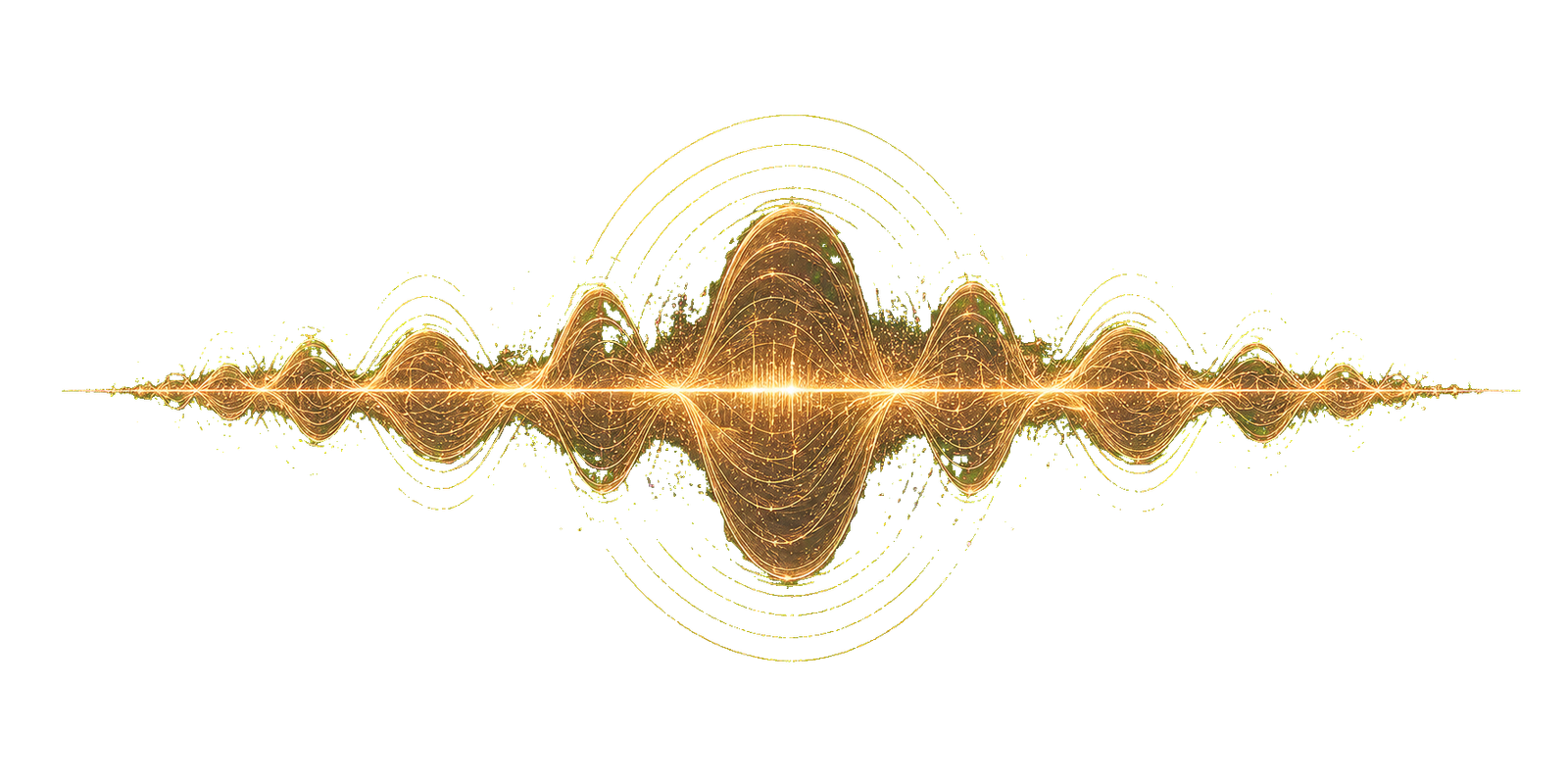
What Sonus AI observes
How many times the signal oscillates per second and with what intensity — the basis for everything perceived as low, high or loud.
How the waves align with each other and how the signal's energy is distributed across the frequencies that compose it.
The multiple frequencies organized above a fundamental, giving sound its characteristic texture.
Repetitions, periodicities and transformations that the sound structure takes on throughout the signal's duration.
The originating question
Sonus AI is born from a simple question, one rarely explored outside acoustics laboratories: is it possible to objectively see what is organized inside a sound?
Is it possible to make the structure of a sound signal visible without assigning meaning to it?
Unlike tools built for speech recognition or audio classification, Sonus AI doesn't try to say what a sound "means." Its function is to measure how the signal is organized — and make that organization visible.
What it can measure · what it cannot claim
Objective quantities of the digital signal: sample rate, bit depth, peak and RMS, zero-crossing rate, frequency spectrum, fundamental frequency and harmonic partials, number of events, repetitions and periodicity. Every measurement carries the method, the parameters and the margin of uncertainty used to reach it.
Sonus AI does not identify emotions, intentions, words or meaning in sound. Semantic labels only appear in the last analysis layer (Hypothesis) and are always marked as reversible — never as fact. No layer rewrites the result of the previous one.
Scientific foundation and methodology
Every Sonus AI analysis goes through five stages, each traceable back to the original audio sample:
This design is what makes it possible to audit any Sonus AI result: just follow the chain back to the sample that originated it.
Where we stand
Sonus AI has completed its scientific-foundation phase and is now in the experimental-development stage.
Today, the architecture already produces complete structural-analysis reports — signal format, temporal measurements, spectrum, harmonic structure, patterns and hypotheses — documented and traceable, available for review inside Laboratório 369.
Scientific foundation complete · In development
What comes next
Sonus AI's first four layers — Measurement, Structure, Pattern and Context — operate on objective, reproducible criteria. The fifth layer, Hypothesis, is where the project takes on its most speculative direction.
Sonus AI is born from a long-standing curiosity: investigating whether the harmonic structure of sound can reveal patterns inspired by the idea of "vibrational strings." This vision is treated as a direction to be tested — not as established science — and that's precisely why it lives isolated in the last layer, without contaminating the objective measurements of the earlier layers.
The project's next phase expands this hypothesis layer: more labeled data, more signals analyzed and, eventually, an intelligence architecture capable of proposing — always reversibly — structural relationships between different sound signals.
References and fields of investigation
Sonus AI's development rests on already-established fields of science and engineering, combined in its own way to support its five analysis stages:
The Hypothesis layer, being speculative, is treated separately: as an open field of investigation, not as consolidated scientific body of knowledge.
Sonus AI is still in the experimental-development phase inside Laboratório 369. There is no public access to the tool for now.